Energy
LNG Atlas
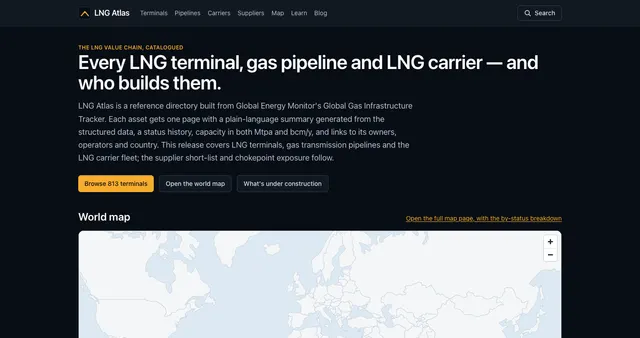
LNG Atlas is a reference directory for the infrastructure of liquefied natural gas and gas transmission.
World Power Monitor is an electricity data website that combines country-level generation and emissions statistics with live operator feeds where public data is available.
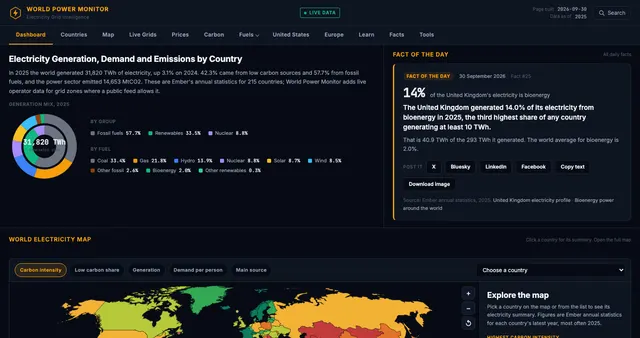
World Power Monitor is an electricity data website that combines country-level generation and emissions statistics with live operator feeds where public data is available. Its central question is how electricity is produced, consumed, traded, priced, and associated with carbon emissions around the world. The homepage describes annual statistics for 215 countries from Ember and adds live information for supported grid zones. The reviewed page clearly distinguishes its build date from the statistical observation year, an essential detail in a product whose navigation also uses live-data language. Annual national totals and current grid readings are separate products with different time scales.
The dashboard introduces global electricity generation by fuel and by broader groups such as fossil fuels, renewables, and nuclear. It includes a world map with selectable views for carbon intensity, low-carbon share, generation, demand per person, and main source. Country pages and fuel sections make it possible to investigate one national system or compare the role of coal, gas, hydro, wind, solar, bioenergy, and other sources. A sourced fact of the day provides an accessible entry point into the larger dataset, with links to the relevant country or ranking.
The site extends beyond annual totals into a substantial set of electricity-market and grid topics. Navigation includes live grids, retail and wholesale prices, cleanest hours, negative prices, cross-border flows, regional summaries, United States state data, and European electricity information. These sections can help explain why a national annual generation mix is not the same as the mix serving a specific place at a specific hour. The reviewed footer names EIA, Ember, and ENTSO-E among its sources and explicitly warns that wholesale or statistical figures are not what a household necessarily pays.
For exploration, the site offers country comparisons, a carbon calculator, grid lookup by ZIP code, a country explorer, records and rankings, year-in-review material, monthly reviews, and transition timelines. Data downloads, a free API, embeddable widgets, feeds, zone alerts, and a weekly digest suggest use cases beyond casual browsing. A daily electricity quiz draws questions from already published site data, linking answers back to the source pages. Learning material and a glossary help readers interpret units and distinguish capacity, generation, demand, prices, and intensity.
A typical user could start with a country's profile, inspect its fuel mix, compare another country on a compatible year, and then open the original data source. Another could use a supported live-grid page to understand current regional conditions while recognizing the feed's delay. Educators, energy journalists, climate researchers, policy readers, and technically curious consumers are plausible audiences. The product's breadth makes it a useful orientation tool, though household scheduling or commercial decisions require attention to the relevant local tariff and current operator information.
Several limitations are visible in the design itself. Compiled statistics can lag real time by weeks or longer, live coverage is not universal, and source definitions may differ. A carbon-intensity number requires its stated calculation basis; it should not automatically be compared with another publisher's differently defined measure. The reviewed search page also exposed an unavailable-search message, showing that navigation availability can vary independently of the data catalog. Overall, World Power Monitor combines accessible national electricity profiles, interactive comparisons, and supported live-grid context. Its strongest use is understanding and tracing electricity data, rather than treating every dashboard value as a simultaneous, exhaustive, operational measurement.
A source list for World Power Monitor has not been added to this hub yet. Under the network's sourcing principles, every figure on a network site is attributed to a named source.
LNG Atlas is a reference directory for the infrastructure of liquefied natural gas and gas transmission.
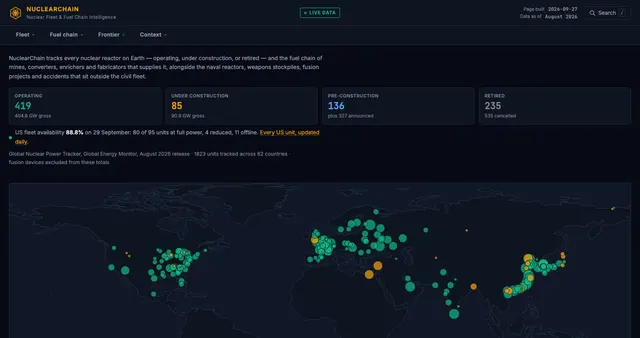
Nuclear Chain is a reference and data-exploration website about nuclear reactors and the industrial chain that supports them.
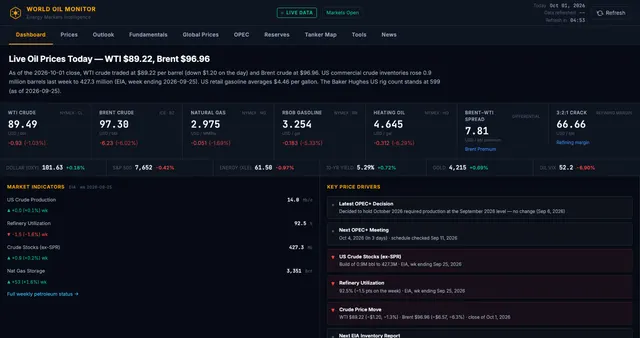
World Oil Monitor is an energy-market dashboard and reference website focused on oil prices, petroleum fundamentals, related fuels, and the wider industrial context of energy markets.
Explore site : World Oil Monitor Overview of World Oil Monitor
We use required browser storage to remember this choice. It is needed for the site to work as intended and is never used for tracking.
If you choose “Accept all”, we also use Google Analytics cookies to count visits and see which pages are useful.
“Accept required” gives you full access to every page. You can change your choice at any time from “Cookie choices” in the footer. Privacy policy