Energy
LNG Atlas
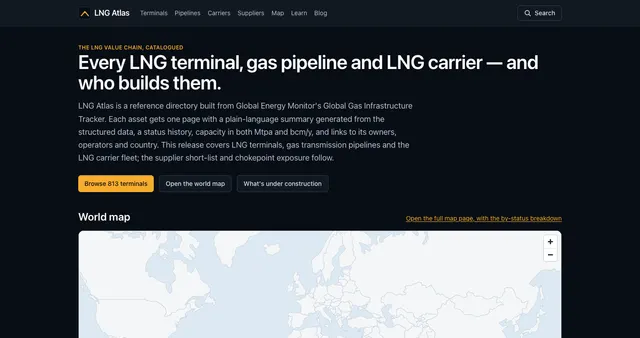
LNG Atlas is a reference directory for the infrastructure of liquefied natural gas and gas transmission.
World Oil Monitor is an energy-market dashboard and reference website focused on oil prices, petroleum fundamentals, related fuels, and the wider industrial context of energy markets.
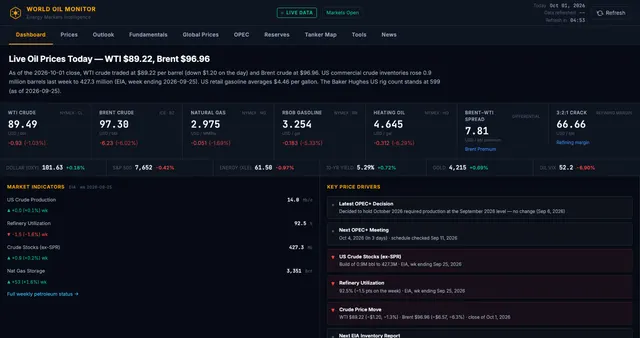
World Oil Monitor is an energy-market dashboard and reference website focused on oil prices, petroleum fundamentals, related fuels, and the wider industrial context of energy markets. Its homepage combines a market tape with benchmark prices, inventory and production indicators, refinery activity, strategic reserves, OPEC developments, and links to explanatory material. The core audience is readers who want to understand how prices connect with supply, stocks, refining, and policy. It is an informational product, not an execution platform or a personalized investment service, and the timing of each displayed figure is central to its interpretation.
The price layer covers WTI, Brent, natural gas, gasoline futures, and heating oil, along with energy-company and sector tickers. Price pages offer history charts, spreads, refining margins, term structure, forward curves, and seasonality. These views explain that a spot-like headline quote, a daily close, and a future delivery contract are different observations. The homepage itself notes that live quotes and latest daily closes can differ. The reviewed static page also included loading and clock placeholders, so the existence of a live label should not be treated as evidence that every widget was fully loaded or simultaneously refreshed.
Fundamental information includes EIA weekly inventories, crude production, refinery utilization, gasoline and distillate stocks, and natural-gas storage. A driver panel places these alongside recent OPEC decisions, the next meeting, and the next inventory release. Other sections cover official outlooks, global benchmark grades, producing and consuming countries, price history, pump-price components, diesel markets, natural gas, company directories, United States basins, and strategic petroleum reserves. Together these create a broader reference around the prices rather than a dashboard that offers numbers without economic context.
The methodology identifies sources and cadences. It describes front-month futures and monthly WTI contracts from Yahoo Finance refreshed at five-minute intervals, EIA data rechecked hourly despite weekly publication, public benchmark tables, and RSS headlines from energy publishers. Strategic-reserve data mixes an automatically updated United States series with source-dated manually curated national figures. That means a comparison of countries' reserves requires attention to dates, units, and conversion assumptions. News sentiment and category labels are automatically derived from headline text, not independently established editorial judgments.
Educational sections explain concepts such as backwardation, contango, refining crack spreads, and the difference between crude benchmarks and retail fuel prices. A reader can move from a dashboard value to a glossary or methodology page, inspect the source, and understand why one statistic might lead or lag another. Tools, daily summaries, market-pulse material, a tanker-map link, news, and daily facts provide additional discovery paths. Estimates and calculated margins remain dependent on their inputs and conventions rather than guaranteed commercial results.
A typical workflow is to inspect the latest benchmark, compare its daily move with inventory changes, read the relevant release, and then investigate the broader production or policy context. Students, energy journalists, business readers, and market observers are plausible users. The site warns that prices are indicative and can be delayed, while compiled fundamentals have their own observation weeks. Overall, World Oil Monitor combines a financial dashboard presentation with a source-based energy reference. Its strongest contribution is to make the relationships among prices, fuels, inventories, refining, companies, and policy easier to explore, while requiring careful separation of live quotes, delayed closes, weekly reports, and modelled interpretations.
A source list for World Oil Monitor has not been added to this hub yet. Under the network's sourcing principles, every figure on a network site is attributed to a named source.
LNG Atlas is a reference directory for the infrastructure of liquefied natural gas and gas transmission.
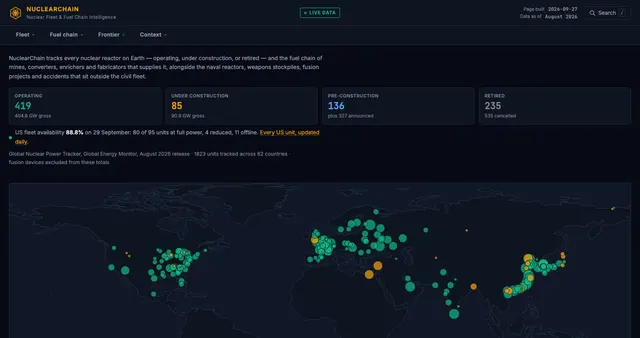
Nuclear Chain is a reference and data-exploration website about nuclear reactors and the industrial chain that supports them.
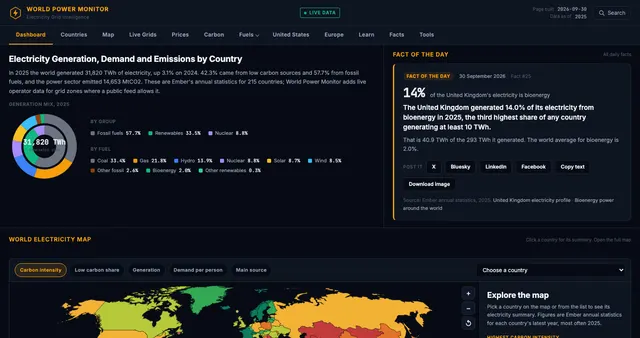
World Power Monitor is an electricity data website that combines country-level generation and emissions statistics with live operator feeds where public data is available.
Explore site : World Power Monitor Overview of World Power Monitor
We use required browser storage to remember this choice. It is needed for the site to work as intended and is never used for tracking.
If you choose “Accept all”, we also use Google Analytics cookies to count visits and see which pages are useful.
“Accept required” gives you full access to every page. You can change your choice at any time from “Cookie choices” in the footer. Privacy policy