
Nutrition
Food Additive Index
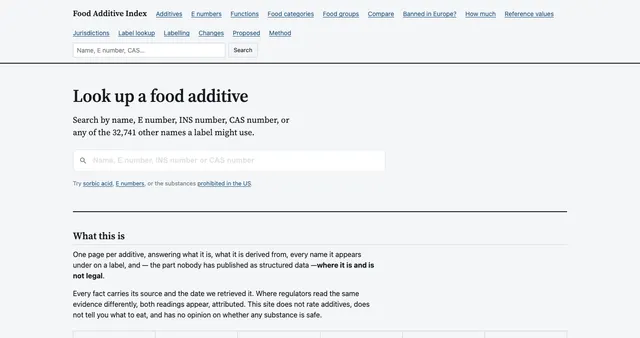
Food Additive Index is a structured reference website about food additives, their identities, and how regulators treat them.
Explore site : Food Additive Index Overview of Food Additive Index
Supplement Label Index is a market-level analytics website about what United States dietary supplement labels declare.
Supplement Label Index is a market-level analytics website about what United States dietary supplement labels declare. Its data comes from the NIH Dietary Supplement Label Database, or DSLD, rather than laboratory testing or personal product reviews. The reviewed homepage described 121,959 on-market product records, 5,801 brands, and 69 tracked compounds from a January 2026 data dump. Its stated goal is to reveal ingredient forms, dose distributions, excipient use, brand patterns, and changes in the label dataset. It is explicitly not a best-products list, purchase recommendation service, or proof that a supplement is safe or effective.
The main browsing paths include compounds, brands, excipients, reports, insights, news, and blog material. Compound pages examine declared doses and forms; brand pages summarize patterns across qualifying product portfolios; excipient pages explore fillers, colors, and sweeteners. Tools and navigation include form comparisons, brand comparisons, a data explorer, trending material, newly listed products, a monthly digest, a market summary, a glossary, and guidance on reading a label. This structure allows visitors to investigate the market from an ingredient, formulation, or company perspective rather than through retail popularity rankings.
Flagship reports turn the compiled labels into specific research questions. The homepage highlighted prenatal nutrients, children's products, gummy dose differences, low-cost ingredient forms, additives restricted elsewhere, and Formula Twins. The latter looks for products with identical or near-identical declared formulas sold under different names. Such a finding can suggest white-label patterns, but it remains a comparison of label records rather than proof that manufacturing, quality control, or actual contents are identical. The distinction between declared composition and tested composition is central to interpreting the site's results.
A stack checker adds declared nutrient amounts across products and places them beside adult recommended intakes and upper limits. That can make label arithmetic more accessible, but it cannot establish an individual's need, total dietary intake, interactions, or clinical risk. The site repeatedly directs readers to qualified healthcare professionals for personal supplementation advice. Its ingredient-form tiers refer to cited comparative bioavailability or clinical literature, and the methodology says forms are left unrated when no comparative evidence is found. A category label is therefore not a blanket clinical judgment about every product containing that form.
The methodology provides important constraints on coverage. DSLD combines survey-sourced records with voluntary manufacturer submissions and is not a complete market census, despite the homepage's census-bureau metaphor. A product's on-market flag can lag actual retail availability. Values are manufacturer-declared rather than independently verified by the site or NIH. Statement-type buckets are heuristic classifications based on dataset labels, not legal determinations. The published workflow describes monthly refreshes, comparisons with prior dumps, and recomputation of reports; readers still need to inspect the displayed dump date before assuming recent shelf changes are included.
Formulators, clinicians, dietitians, journalists, researchers, and curious consumers are plausible users. A typical workflow could start with magnesium or collagen, inspect declared forms and doses, compare brand patterns, and then open the underlying data and cited literature. News links and articles provide additional context without turning the catalog into health advice. Overall, Supplement Label Index is best understood as a source-aware analysis of label declarations. Its strongest value is revealing aggregate patterns that are hard to see one bottle at a time, while keeping the limitations of database coverage, manufacturer claims, and clinical interpretation visible.
A source list for Supplment Label Index has not been added to this hub yet. Under the network's sourcing principles, every figure on a network site is attributed to a named source.
Food Additive Index is a structured reference website about food additives, their identities, and how regulators treat them.
Explore site : Food Additive Index Overview of Food Additive Index
We use required browser storage to remember this choice. It is needed for the site to work as intended and is never used for tracking.
If you choose “Accept all”, we also use Google Analytics cookies to count visits and see which pages are useful.
“Accept required” gives you full access to every page. You can change your choice at any time from “Cookie choices” in the footer. Privacy policy